On Death

In his Journal, John Wesley relates this incident: “Today I visited one who was ill in bed. She had buried seven of her family in six months, and had just heard that her beloved husband was cast away at sea. I asked, “Don’t you fret at any of these things?”

She answered with a loving smile on her pale cheeks, “Oh, no! How can I fret at anything which is in the will of God? Let Him take all besides; He has given me Himself. I have learned to love and praise Him every moment.”*

The Risen Shepherd asks His people to believe in a reality we often do not feel. One such reality has to do with death. As I follow Jesus I must learn to think about death and train my emotions to feel a certain way about death. For Jesus and His people, death has a very different feel than what is common to culture.

When we think and feel about death as Jesus would have us think and feel, we experience settled peace, our courage to give and suffer increases, and a growing delight at the prospect of being with the Lord changes our appetites. Of course, the opposite is true. If we think and feel about death as the world does, then we can be confident we will make many poor decisions and live under a nagging fear.

For our loved ones who are in the Lord we are wise to remember that their death is never a “surprise” or an “accident.” From our mother’s womb to the day we qualify for the tomb, God already knows.

“Your eyes saw my unformed body;
    all the days ordained for me were written in your book
    before one of them came to be.”

Psalm 139:16 (NIV)

The death of a Christian is simply God bringing to Himself the precious person that had been on loan to us. Jesus said, “I will take you to be with me.” (John 14:3). The Apostle Paul explains that for followers of Jesus to be away from the body is to be at home with the Lord (2 Corinthians 5:8).

“I must not think it strange if God takes in youth those whom I would have kept on earth till they were older. God is peopling Eternity, and I must not restrict Him to old men and women.” Jim Elliot

In a letter written in 1628 to a Christian woman who had just lost her teenage daughter, Samuel Rutherford asks, “Do you think her lost, when she is but sleeping in the bosom of the Almighty?”

Our loved ones who die in Christ, and indeed our death, is God’s wonderful gift of bringing us more fully to Himself.

We can grieve when news arrives of our loved one’s death. But let’s remember heaven never shed’s a tear over the of a saint.

*(Tan, P. L. (1996). Encyclopedia of 7700 Illustrations: Signs of the Times (p. 1609). Garland, TX: Bible Communications, Inc.)

One Question to Ask in Every Conflict

The Scripture portrays life with Christ like a pasture that is green (see Psalm 23, John 10). There is a fruitful, abundant experience designed by the Risen Shepherd.

We are not alone in our life with Christ. Jesus brings us into life with Himself and we’re brought into relationship with other people. Because I am in process of becoming like Jesus and you are in process of learning to love like Jesus, conflict occurs.  

I have a bull named Hans. He is rather protective of his herd and much too aggressive. He has chased after people who venture into the pasture. Being in the pasture with Hans is very uncomfortable. I’ve met people who are as “friendly” as Hans the bull. They are just not safe, but in order to be obedient to Christ I must share life with them. And truth be told, for too often I have been “Hans the bull.”

not Hans the bull, just a good looking calf from my son’s cow

My wife and I have been married, to each other, for almost 2 and half decades. Within the last 16 months we’ve willingly leaned into a tremendous amount of transition. I was completely unprepared for adverse effect the prolonged stress and uncertainty would have on my own soul and my marriage. Even as we are taking some really big steps of faith to please God and “make an impact for eternity”, we faced one of the hardest years in our  marriage.

In the wise providence of God, life is still uncertain and harder than we’re accustomed, but in this process, I inadvertently learned a lesson about conflict (and thus marriage) that I had apparently missed until this point in my life. I picked it up in a book written by William Law in 1729.

Bad Conflict Strategy

The human brain has three instinctive responses when faced with a physical threat: fight, flight, freeze. Sadly I’ve responded to conflict with all three approaches. My favorite, however, is a knock-down, drag out verbal fight. And if I can’t actually have a war of words, then I craft masterful arguments in my mind.

Before I know it I’m following in the vengeful footsteps of Lamech (Genesis 4:23). Lamech was the seventh generation born after Adam, one of Cain’s descendants. Lamech lived by the ideology: “hurt me a little bit and I will hurt you back much worse.”[1]

Fight, flight, or freeze is a terrible way to respond to conflict.

William Law Boils it Down

In his classic work A Serious Call to  Devout and Holy Life, Law identifies the one question every Christian should ask when faced with a conflict: “How can I please God in this?”

While my instinct is to respond to conflict like a country preparing for war, God has been training me to see conflict with through the lens of this simple question: “How can I please God in this conflict?”

This is hard to ask, my mind is racing with long lists of offenses and emotions are raging. But like the wind that clears the smoke from the fire this simple question reorients my soul to heaven.

How Can I Please God in this?


[1] The Bible is pregnant with meaning. Notice what Genesis 4:25-26 says about Seth. Genesis 5 lists the descendants of Seth. Lamech is seven generations from Adam. Notice how the Bible describes the seventh generation from Adam in the lineage of Seth. What do you think God wants you to learn about from this rich detail?

What Do I Say When I Pray?

Add this oft-forgotten element to your prayer life.

There are two particular challenges I face when I attempt to pray. Either I have intensely distracting thoughts and cannot listen or I don’t know what to say. In this article I want to show you one element that should be part of your prayers. There is a certain category of words that should be added to your life of prayer. But usually I (and probably you as well) haven’t given much attention or effort to this category.

A Better Way of Thinking

We could think of prayer as a portal to the Presence of God. God is everywhere. Paul, an apostle of Jesus Christ, wrote about God, “In Him we live and move and have our being” (Acts 17:28 ESV). God is always present. I think of the powerful poetic expression of Psalm 139 “if I go_____, you are there!”

Sometimes Jesus-people say about a particular worship service or prayer time:  “God was really present today” inferring there are times when God is absent. This is grossly inaccurate and tells the wrong story about the Living God.

It’s more accurate to say “I was present to God today” or “I wasn’t very present to God today.” Prayer rightly practiced is thin veil we cross in order to experience the present Presence. It’s prayer that moves me from the shade into the warm light of the sun.

What to Say When I Pray

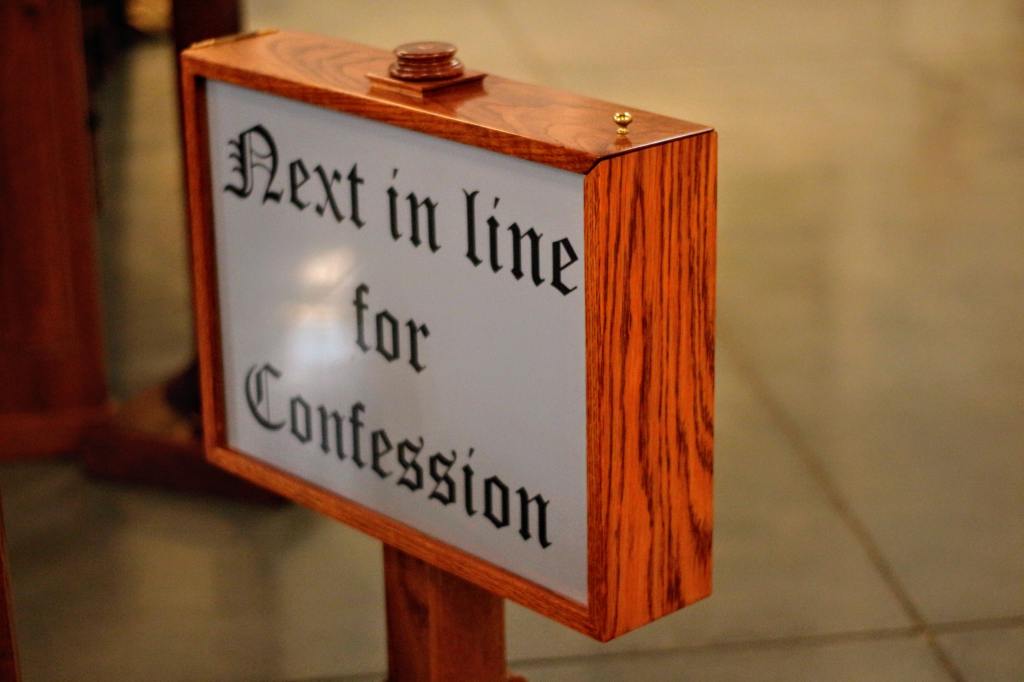
Intensely distracting thoughts or not having words to say beyond trite prayer-cliches can leave one blind and deaf to the present Presence. One of the ways we win against distracting thoughts or meaningless phrases is purposefully adding the element of confession to our life of prayer.

Confession is practice of naming what’s real. It’s about ownership. For me the regular practice of running trims my body-fat and for all of us the regular practice of confession trims our ego and bounds our anxiety.

Because God is always everywhere my prayers never need to inform God. Jesus was quite clear, the Father already knows (Matthew 6).  In this act of confession I become present to the Presence. For too often, the veil that separates me from God is a veil of my own making.

So try this, in your prayer time, when it’s your turn to talk, invite the Holy Spirit to help you practice confession.

  1. Name any ways in which you have departed from the Law of Christ. If you ask Him, the Holy Spirit will bring to mind sins that have tangled up your soul.
  2. Name any anxiety and desires tugging at your mind. Here is where distracting thoughts meant to keep you from the present Presence serve us well. What or who are we constantly thinking about. Give these thoughts to God like a gift to your father on Christmas morning.  
  3. Name the needs. I’ve heard Christians say, “I don’t really prayer for myself” as though this is a sign of maturity.  It pleases the Lord when we confess the problems that are too big for us to solve, the needs too complex for our solving and the hurts we’ve never been able to make whole. Present your requests to God (Philippians 4:6).

Sweet Freedom

In the regular practice of confession offer yourself to God. Be vulnerable and intimate with the one who knows you best and loves you most. C.S. Lewis wrote, “We must lay before Him what is in us, not what ought to be in us.”

Want to Pray Like Jesus… Do This.

Shift from communication to communing  

My car stalled part-way out the drive-way. My boys and I thought we were on our way in to help set up for the Sunday worship service, instead we’re quickly finding a chain and towing the car out of the way.  

What could be wrong… failure of the plugs and wire, moisture in the distributor, a crack in head gasket? Maybe. Or maybe it has something to do with the fact that there is no oil registering on the dip-stick. Something is seriously wrong under the hood and there is no power and no movement.

Prayer is one of the most impactful practices in your life with Christ. William Law wrote that God is closer to us than our own bodies and it’s prayer that unites us to God-Who-is-Close. 

Jesus was a master at prayer. His prayer life kept Him close to the Father, gave Him insight, wisdom, power and sustaining energy (Mark 1:35, Luke 6:12, Luke 22:43).

While prayer is so critical, for most us we can’t get out of the driveway. 

Tired of Feeling Guilty 

Odds are, you and I are part of the huge percentage of people that feel guilty about our prayer-life… or more accurately our lack of a life of prayer. But no matter how guilty we feel about our powerless prayer-life, feeling bad about it doesn’t seem to create any positive movement.  

Like yeast in the bread dough, I’m learning there is one ingredient necessary to give life and zeal to our practice of prayer. While spiritual practices, accurate knowledge of God, and regular accountability are all super important elements if we’re going to pray like Jesus, we’re still not going anywhere without this one crucial shift in our thinking. 

The Most Important Shift in Prayer 

Vibrant, effective, life-giving prayer arises from shifting our definition of prayer from communicating to God to communing with God. Prayer is no longer about controlling God, getting something from God, proving our faithfulness or words on top of words. Christian prayer is different. Praying like Jesus means our goal is simply this: being with the Father.  

Communicating to God is good. It’s an act of humility to name our needs, present our worries, and own our sins. In communicating to God I can echo the angels in heaven by declaring the splendor and wonder of God. One of the ways you’ll measure your life of prayer is by the frequency and content of your communication to God. But you probably won’t develop a life of prayer by saying more and better words.  

With not To 

Prayer is so much bigger than just saying words. I love my wife. I will say loving words to her. Spoken words of affection are an important element of love, but you’d understand her frustration if my love was never more than words. If I walked in the house after work, spewed nice words for five minutes and then proceeded to ignore her the rest of the evening my life with her would be a shallow version of what it could be! In the same way love is bigger than spoken words, so prayer is more than just the content of our speech to God.  

Prayer is being with God.   

“Prayer does not mean asking God for what we want; it is rather the desire for God himself. It is not asking but union with God. It is breathing and living in God.” Sadhu Sundar Singh 

Sadhu Sundar Singh: Essential Writings. ed. Charles E. Moore.

So try this: stop thinking of prayer as merely an act of asking and telling. In the same way you might step out of the house in order to enjoy the sunshine, take some moments to step out of preoccupation and enjoy the fact of God’s nearness. Find a chair or a stump and be.  

See Luke 6:12; James 4:8; Acts 17:28